Welcome to this concise U.S. Census Bureau documentation, our main aim is to consolidate frequently used information, offering a quick kick-start for your Census journey.
This documentation specifically focuses on the following commonly used products:
- The American Community Survey (U.S. Census Bureau)
- ACS 1-Year Estimates
- ACS 5-Year Estimates
- The Decennial Census
Acknowledgment: The resources compiled in this documentation are sourced from the US Census Bureau, and it is important to note that this guide is not intended as a replacement for official Census Bureau materials. For the most accurate and up-to-date information, always refer to the official resources provided by the US Census Bureau.
In addition, the Developer’s Forum on Slack - is an active community that proves invaluable for obtaining expert answers to your queries from the knowledgeable professionals at the U.S. Census Bureau.
- [Q1] What are ACS 1-Year Estimates?
- [Q2] What are ACS 5-Year Estimates?
- [Q3] When to use 1-year or 5-year Estimates?
- [Q4] What is Decennial Census?
- [Q5] What are key differences between Decennial and ACS?
- [Q6] How to Obtain Your Census API Key??
- [Q7] How do I find the geographical coverage of a dataset/table?
- [Q8] What Variables are Available in a Dataset/Table?
- [Q9] How do I download the values of a specific census variable?
- [Q10] How do I choose variables from Census datasets?
The American Community Survey (ACS) 1-Year Estimate is an annual survey conducted by the U.S. Census Bureau to provide timely and reliable demographic, social, economic, and housing information for communities across the United States.
-
Time Period 2005-present
-
Frequency The ACS 1-Year Estimate is released annually and covers a broad range of topics, allowing for more up-to-date information compared to the traditional decennial census.
-
Sample Size Unlike the full decennial census, which aims to count every person in the United States, the ACS is based on a sample of households. The 1-year estimate is drawn from a one-year sample, providing a snapshot of the population's characteristics during that specific year.
-
Geographic Coverage The ACS 1-Year Estimate provides data for a variety of geographic areas - all 50 states, the District of Columbia, Puerto Rico, every congressional district, every metropolitan area, and all counties and places with populations of 65,000 or more.
-
Data Variables The survey collects information on a wide range of topics, including but not limited to population, age, sex, race, ethnicity, education, employment, income, housing, and commuting patterns.
-
Reliability While the 1-year estimate offers more recent data, it is based on a smaller sample size compared to the 5-year estimate. As a result, caution should be exercised when interpreting data for smaller geographic areas or subpopulations.
- ZCTA Coverage ZCTA coverage is not included in ACS 1-Year Estimates.
- Population Threshold The data is available only for regions with a population of 65,000 or more.
- Impact of COVID-19 Due to the impact of the COVID-19 pandemic on data collection, the Census Bureau did not release its standard 2020 ACS 1-year estimates.
- Variable Changes Some variable changes occurred; refer to this link for all the details.
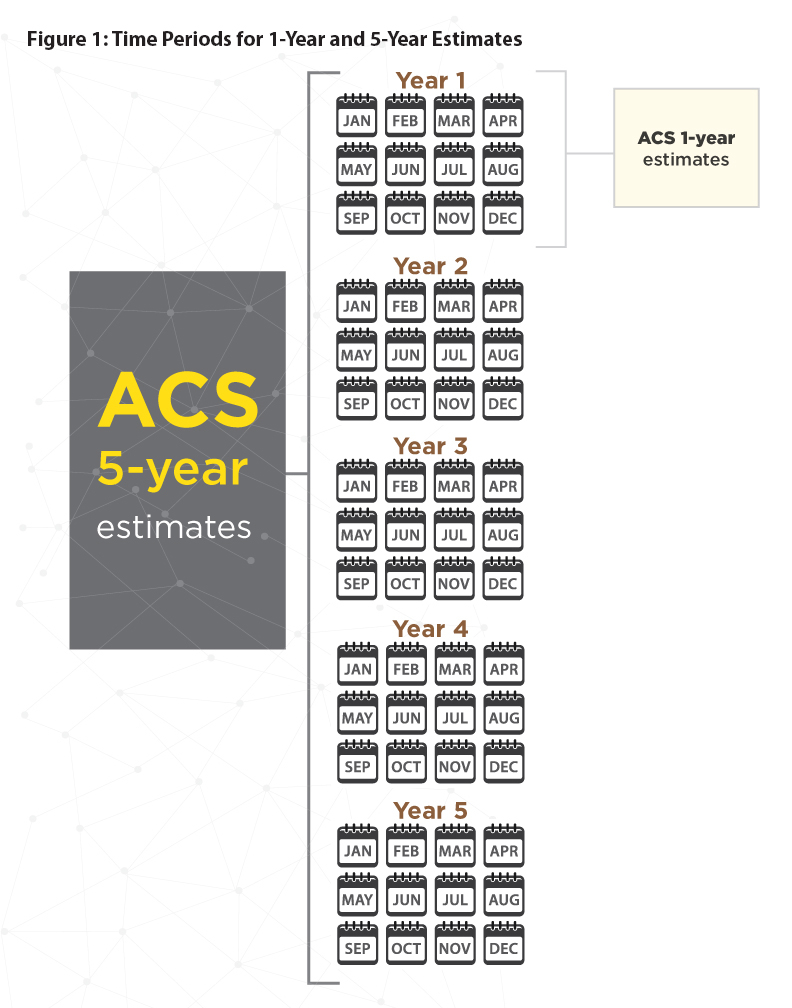
The American Community Survey (ACS) is an ongoing survey that provides data every year -- giving communities the current information they need to plan investments and services.The 5-year estimates from the ACS are period estimates that represent data collected over a period of time. The primary advantage of using multiyear estimates is the increased statistical reliability of the data for less populated areas and small population subgroups.
The below image from the US Census Bureau, effectively illustrates the time period covered by ACS 1-Year and 5-Year estimates.
-
Time Period 2005-2009 - 2018-2022 (latest release)
-
Frequency While the ACS 1-Year Estimate provides annual snapshots, the 5-Year Estimate spans a 60-month period, offering a more stable dataset for in-depth analysis. This extended survey period minimizes the impact of yearly fluctuations, making it particularly useful for understanding long-term trends.
-
Sample Size Unlike the full decennial census, the ACS 5-Year Estimate is based on a larger sample size, as it combines data from five years. This results in a more robust dataset, especially beneficial for smaller geographic areas and subpopulations.
-
Geographic Coverage The 5-year estimates are available for all geographies down to the block group level. include the following geographies: nation, all states (including DC and Puerto Rico), all metropolitan areas, all congressional districts (116th congress), all counties, all places, all tracts and block groups.
-
Data Variables Similar to the 1-Year Estimate, the 5-Year Estimate covers a broad range of topics about social, economic, demographic, and housing characteristics of the U.S. population.
-
Reliability The 5-Year Estimate, with its larger sample size, offers increased reliability for smaller geographic areas and subpopulations. However, it's important to note that it may not capture very recent changes, so users should be cautious when interpreting short-term trends.
ZCTA Coverage ACS 5-Year Estimates data is available from 2005-2009 onwards; however, ZCTA (ZIP Code Tabulation Area) level information is available from 2007-2011 onwards.
Variable Changes Some variable changes occurred; refer to these links for all the details:
- ACS5 2018-2022 table changes
- ACS5 2017-2021 table changes
- ACS5 2016-2020 table changes
- ACS5 2015-2019 table changes
- ACS5 2014-2018 table changes
- ACS5 2013-2017 table changes
- ACS5 2012-2016 table changes
- ACS5 2011-2015 table changes
- ACS5 2010-2014 table changes
- ACS5 2009-2013 table changes
- ACS5 2008-2012 table changes
- ACS5 2007-2011 table changes
- ACS5 2006-2010 table changes
For guidance on when to utilize either the 1-Year or 5-Year Estimates, refer to this resource, which provides a clear comparison of the two and offers recommendations on suitable use cases for each.
Every 10 years, the U.S. Census Bureau conducts a census to determine the number of people living in the United States.
Available for the years 2000, 2010, 2020 through the Census API.
- Data tables from the 1990 census are not available through the census API or data.census.gov. To get tables from any U.S. census back to 1790, you could use nhgis.org, which also has an API.
- The Bureau has redesigned its summary files for the 2020 census. The 2020 DHC (Demographic and Housing Characteristics File) provides most of what was previously available in the Summary File 1 (SF1).
| Feature | ACS (American Community Survey) | Decennial Census |
|---|---|---|
| Frequency | Conducted every month, every year | Conducted every ten years |
| Target Addresses | Sent to a sample of addresses (about 3.5 million) | Counts every person living in the 50 states, District of Columbia, and the five U.S. territories |
| Geographic Scope | 50 states, District of Columbia, Puerto Rico | 50 states, District of Columbia, five U.S. territories |
| Survey Topics | Topics include education, employment, internet access, transportation | Asks a shorter set of questions, such as age, sex, race, Hispanic origin, and owner/renter status |
For further information refer to this page.
To obtain your Census API Key, follow these steps:
- Sign up on the Census Bureau's API platform by visiting this link.
- Complete the registration process.
- You will receive an email containing your Census API Key.
Once you have obtained your API key, you can use it to access the Census Bureau's data through their API.
Note: Not all geographies are uniformly supported across all years.
It is possible to navigate through the Census API webpage to find the geographical coverage for each data product, along with its corresponding table or dataset, in a particular year.
For instance, if you wish to identify the supported geography for ACS-5 year 2013-2017 estimates, you have to fill the specifics in the following url:
https://api.census.gov/data/<year>/<product_name>/<dataset>/geography.htmlFor our ACS5 2013-2017 example, you can access the supported geographies through the following URL: https://api.census.gov/data/2017/acs/acs5/geography.html. The retrieved html allows shows, for example, that the zip code tabulation area is covered in the 2013-2017 ACS5.
It is possible to navigate through the Census API webpage to find the list of variables available for each census dataset in a particular year.
For instance, if you want the list of variables for the ACS-5 year 2013-2017 table, you have to fill the specifics in the following url:
https://api.census.gov/data/<year>/<product_name>/<dataset>/variable.htmlFor our ACS5 2013-2017 example, you can access the list of variables through the following URL: https://api.census.gov/data/2017/acs/acs5/variables.html.
The census_script.py script contains code to download the census variables for a specific geographical and time resolution.
The census_custom_variable_script.py script contains code that allows to extract custom census variables for a specific geographical and time resolution.
Follow this notebook acs5_vars_nlp_exploration.ipynb where you can leverage basic NLP to explore the extensive number of variables US Census surveys/datasets offer.
- The online home of Analyzing US Census Data: Methods, Maps, and Models in R, a book published with CRC Press in 2023.
- Getting census data over time. Andrew P Wheeler
- Evaluating Linearly Interpolated Intercensal Estimates of Demographic and Socioeconomic Characteristics of U.S. Counties and Census Tracts 2001–2009 doi: 10.1007/s11113-015-9359-8)