


A manager approves, then the CFO. Unless it's over $50k — then Legal too.
Every app eventually grows an approval step. It starts as an approved boolean
and an approved_by_id. Then Finance wants a second signature over $10k. Then
Legal and IT have to review the same contract at the same time. Then someone
goes on leave and their queue backs up. Then an auditor asks who approved
invoice #4471 and on whose behalf — and the honest answer is that it is spread
across three callbacks and a status column you have already overwritten twice.
ApprovalEngine is the generic machinery for that, extracted: an append-only ledger of who decided what, routing rules your admins change without a deploy, and side-effects that can't roll back an approval. You decide what gets approved, who approves, and what happens next.
- A ledger, not a flag.
Approval → Track → Step, append-only. A rejection or a request for changes appends a new iteration; nothing is overwritten, so the history survives the question. - Rules, not
ifs. Routing lives in the database as JSON Logic, scoped per tenant. "Over $10k" becomes "over $25k, unless EMEA" without a deploy. - An outbox, not callbacks. Side-effects run through a transactional outbox on ActiveJob, so a down payment API can never roll back an approval.
Needs PostgreSQL 13+ (the routing engine uses jsonb and gin; the tables key
on gen_random_uuid()), Rails 7.1+, Ruby 3.2+.
bundle add approval_engine
bin/rails generate approval_engine:install
bin/rails db:migrate
Then four small edits, and a $20,000 invoice routes itself to a manager and then a CFO:
# config/initializers/approval_engine.rb — the generator wrote this; fill in two lines
ApprovalEngine.configure do |config|
  config.actor_class           = "User"                 # who approves
  config.current_tenant_method = -> { Current.account } # anything with #id

  # `Current` here is your own ActiveSupport::CurrentAttributes class — the
  # engine only ever calls `#id` on what you return. Not multi-tenant? Return a
  # constant instead: `-> { Struct.new(:id).new("default") }`.
end

# app/models/user.rb — who is in a group, resolved at runtime against your own models
class User < ApplicationRecord
  def self.resolve_approval_group(group_name, target)
    where(role: group_name) # `target` is the record being approved
  end
end

# app/models/invoice.rb — arm the model, and declare what a rule may read
class Invoice < ApplicationRecord
  has_approvals

  exposes_for_approval do
    attribute :amount, type: :decimal
  end

  def after_approved
    PaymentService.disburse_funds!(self)
  end
end

# db/seeds.rb — the flow itself. Idempotent, so re-running it on every deploy is safe.
account = Account.find_by!(subdomain: "acme")

ApprovalEngine.define_flow "High-value invoice", tenant: account.id, model: Invoice do
  on :create, when: { amount: { gt: 10_000 } }

  step "Manager sign-off", group: "manager"
  step "CFO sign-off",     group: "cfo"
end

# Anywhere in your app — a controller, a job, a console.
Current.account = account
invoice = Invoice.create!(amount: 20_000)   # over $10k, so it routes itself

step = ApprovalEngine::Step.actionable_by(current_user).first
step.approve!(by: current_user)   # the CFO's step opens; once they approve too,
                                  # `after_approved` fires through the outbox
Create the approvers first: a group that resolves to nobody raises at build time rather than starting an approval nobody can act on.
Nothing triggered? invoice.preview_approval(event: "invoice.created") tells
you what would have happened, before you go any further — see
Gotchas.
Use it when you have:
- Multi-step, human-in-the-loop approvals, sequential or parallel
- Routing rules that admins change at runtime, without a deploy
- A need to audit who approved what, when, and on whose behalf
- Concurrency that must never double-approve
Look elsewhere when:
- One person says yes, once, and nobody will ever ask who. A boolean column and a method is smaller, and smaller is right until it stops fitting — see below for what to do when it does.
- You need a state machine for non-approval domains. Try AASM or state_machines.
- You're not on PostgreSQL. The routing engine needs
jsonbandgin.
You will know: a second approver appears, or somebody asks who approved it, or the threshold has to differ per customer. You don't have to give the column up. It stops being the source of truth and becomes a projection of the ledger, so every query, view, and scope you already wrote keeps working:
class Invoice < ApplicationRecord
  has_approvals

  # The flag you already had. Now it is derived, not decided here.
  def after_approved
    update_column(:approved, true)
  end
end
Day one, nothing else in your app changes. Day thirty, you add the second layer and the audit trail is already there.
Add this line to your application's Gemfile:
gem "approval_engine"And then execute:
bundle install
rails generate approval_engine:install
rails db:migrate
The generator copies migrations and an initializer, and prints next steps.
A flow is three records: a template, its ordered steps, and the rule that says
which event fires it. You can still write those by hand — the admin UI does
exactly that — but for the flows that live in your codebase, define_flow says
the same thing in the shape of the policy it encodes:
ApprovalEngine.define_flow "Vendor contract", tenant: account.id, model: Contract do
  on "contract.submitted", when: { value: { gte: 50_000 } }

  step "Manager sign-off", group: "manager"

  parallel(approvals_required: :all) do
    step "Legal review", group: "legal"
    step "IT review",    group: "it"
  end

  step "CFO sign-off", group: "cfo", timeout_after: 2.days
end
Each step is its own layer, in the order written. Steps inside a parallel
block share a layer and open together, under one consensus policy declared on
the block. Everything a template step takes, step takes: approvals_required
(:any, :all, :majority, a percentage like "60%", or a count) and
timeout_after.
on takes a lifecycle symbol (:create, resolved through model: into the
conventional event name) or any event name you fire yourself, plus when:,
priority: and active:. The when: sugar — { amount: { gt: 10_000 } } —
compiles to the JSON Logic actually stored, using eq, not_eq, gt, gte,
lt, lte, in and not_in; several keys AND together, and anything more
involved can be passed as raw JSON Logic instead.
define_flow is idempotent, keyed on the tenant and the flow name. Run it from
db/seeds.rb, a rake task, or a deploy hook and re-run it as often as you like:
it reconciles the blueprint in place instead of stacking a fourth copy of the
same template. It needs a live database connection, so it does not belong in an
initializer.
Editing a flow does not disturb work already in flight. An approval is stamped from the blueprint when it is built and never reads it again — the steps a manager is looking at right now are the steps that existed when the invoice was created. New runs pick up the new shape.
Two smaller seams. ApprovalEngine.flow(name, tenant:) hands back the
TrackTemplate a definition owns, which is what
run_approval!(templates: [...]) wants when several flows should run as
parallel tracks of one approval. And config.approval_groups is an optional
allowlist of the group names a flow may route to — nil by default, meaning
unchecked, so a typo in group: stops the seed only once you have declared a
vocabulary.
Prefer the records? TrackTemplate / TemplateStep / TriggerRule are still
public API and still work exactly as they did in 1.0 — define_flow writes the
same rows you would have written.
Teach your actor class to resolve approval groups. The engine creates one
step per returned record. target is the record being approved (e.g. the
Invoice); this example ignores it, but you can use it for record-scoped
groups like "this invoice's department head".
class User < ApplicationRecord
  def self.resolve_approval_group(group_name, target)
    where(role: group_name) # `target` available for record-scoped resolution
  end
end
Arm a model and declare the attributes the rules engine may read.
class Invoice < ApplicationRecord
  has_approvals

  exposes_for_approval do
    attribute :amount, type: :decimal
  end

  def after_approved
    PaymentService.disburse_funds!(self)
  end
end
Trigger a run. has_approvals auto-routes on create once
current_tenant_method is set; anywhere else, fire the event yourself.
invoice = Invoice.create!(amount: 20_000)
invoice.run_approval!(event: "invoice.created", tenant_id: "acme")
Verify it routed before going further.
invoice.preview_approval(event: "invoice.created", tenant_id: "acme").triggered?
# => true
Act on a step. actionable_by is the approver's inbox, including delegations.
ApprovalEngine::Step.actionable_by(current_user).first.approve!(by: current_user)This gem fails closed and silent when misconfigured. If a run doesn't
trigger, preview_approval(...).triggered? tells you why. Check:
- The rule's
event_namematches the event you fire. - The template
statusis"active". Draft templates never fire. - Every attribute a rule reads is declared in
exposes_for_approval. config.current_tenant_methodis set. Until then, auto-routing on create is a no-op, so passtenant_id:explicitly.
define_flow is the exception, and deliberately so. It is setup code you run at
deploy, so it raises on a typo instead of failing closed — an unexposed
attribute, an unknown lifecycle, a duplicate step name, and a group outside
config.approval_groups all stop the seed with a sentence explaining themselves.
The engine ships helpers so a host app can drive an approval without hand-rolling fixtures. They are actions and queries rather than assertions, so they read the same under Minitest and RSpec.
# test/test_helper.rb
require "approval_engine/test_helpers"

class ActiveSupport::TestCase
  include ApprovalEngine::TestHelpers
end
invoice = Invoice.create!(amount: 20_000)
assert_equal "Manager sign-off", pending_approval_steps(invoice).sole.name
approve_approval_and_settle!(invoice) # walk every layer, then relay the outbox
assert_equal "paid", invoice.reload.stateapprove_approval! walks each layer as it opens, approving with the step's own
assigned actor unless you pass by:. reject_approval! stops at whatever is
waiting. drain_approval_outbox! is the one to remember — side-effects reach
your model through the outbox, relayed by ActiveJob, so until the queue runs
after_approved has genuinely not fired and a test asserting on it will fail for
the right reason and look like the wrong one.
# config/initializers/approval_engine.rb
ApprovalEngine.configure do |config|
  config.actor_class           = "User"                 # who approves
  config.current_tenant_method = -> { Current.account } # anything with #id
  config.outbox_queue          = :default               # ActiveJob queue for side-effects
  config.raise_on_rule_errors  = false                  # fail closed in production
  config.approval_groups       = nil                    # nil = any group name is allowed
end
current_tenant_method defaults to nil. While it is nil, auto-routing
on create silently no-ops, since the engine cannot scope the rules.
Single-tenant apps can return a constant, e.g.
-> { Struct.new(:id).new("default") }.
No Redis or Sidekiq required. Side-effects run through ActiveJob, so SolidQueue, Sidekiq, or the async adapter all work.
The two surfaces added in 1.1 — notifications and the admin UI — have their own keys, and both are off until you set them. See below.
An approval only works if the approver finds out. In 1.0 that was yours to
build: the engine published the events and you wrote the mailer. It still can —
but for the common case, the engine will now send the mail. It is off by
default, and upgrading from 1.0 does not turn it on: your Step rows are
assigned to real people, and a gem upgrade must not start mailing them.
ApprovalEngine.configure do |config|
  config.notifications_enabled = true
  config.mailer_from           = "approvals@acme.com"
  config.approval_url_builder  = ->(approval) do
    Rails.application.routes.url_helpers.invoice_url(approval.target)
  end
end
Those three are the minimum. Without a From address — either mailer_from, or a
parent_mailer that already declares default from: — Action Mailer has
nothing to hand the SMTP server. Without approval_url_builder the mail arrives
with nowhere to go.
Six messages ship, listed in config.notification_events: an approver is told
they have work waiting (step_activated), nudged if they go quiet
(step_reminder), and told when a step is handed to them (step_reassigned);
the requesting side is told when changes are requested (changes_requested) and
when the approval is approved or rejected (approval_approved,
approval_rejected). Drop one to silence it:
config.notification_events -= [ :step_reassigned ]The last three go wherever config.approval_recipients says — the engine knows
who approves, but only you know who asked, so while that is nil those three stay
silent. The rest resolve off the actor via config.actor_email_method
(:email by default); an actor with no address is skipped, never raised on.
config.actor_label_method and config.target_label_method decide how a person
and a record name themselves in an inbox, and fall back to something readable
rather than an object inspection.
The mails go out through the same transactional outbox as every other
side-effect, so a dead SMTP host can never touch the approval: the transition
has already committed, and only the delivery fails. Delivery is at-least-once,
which for email means an approver may occasionally get the same nudge twice —
the tradeoff for never getting zero. The engine hands the message to
deliver_later and imposes no retry policy of its own, so what happens to a
bounced job is whatever your Active Job backend already does with a failure.
Reminders are a separate, opt-in sweep. Set how long a step may sit unanswered and schedule the job with whatever recurring mechanism you already run:
config.reminder_after = 2.days.to_i # nil (the default) = reminders offApprovalEngine::ReminderSweepJob.perform_later # all tenants
ApprovalEngine::ReminderSweepJob.perform_later(tenant_id: account.id)Each step is nudged at most once, so running the sweep hourly only makes the nudge arrive sooner rather than nagging. That guarantee is on the emission: like every other notification it rides the at-least-once outbox, so a relay retry can still deliver a duplicate copy of the same nudge.
Be deliberate about the first run. reminder_after is measured from when a step
became actionable, not from when you switched reminders on, so the first sweep
nudges every step already past the threshold — on an app with a backlog that
is one large batch of email. Check what it will pick up before you schedule it:
ApprovalEngine::Step.remindable(after: 2.days.to_i).countThe stamp that makes that true lives in a column added in 1.1, so an app
upgrading from 1.0 needs bin/rails approval_engine:install:migrations and
bin/rails db:migrate before scheduling the sweep — nothing else in the engine
reads it.
Make the mail yours by overriding the views: drop your own copies into
app/views/approval_engine/notification_mailer/ and your app's view path is
searched before the engine's. Override both formats of an action together —
Action Mailer takes an action's templates from the first view path that has any
of them, so a lone .html.erb silences the engine's .text.erb and leaves you
with a single-part message. To take a message over wholesale, subclass
ApprovalEngine::NotificationMailer and point config.mailer_class at it, or
point config.parent_mailer at your ApplicationMailer to inherit your layout
and sender. If you would rather send everything yourself, leave
notifications_enabled off and subscribe to the approval_engine.*
notifications
as before. Escalation and what "late" means are still yours: the engine tells
you what happened, not what it should mean.
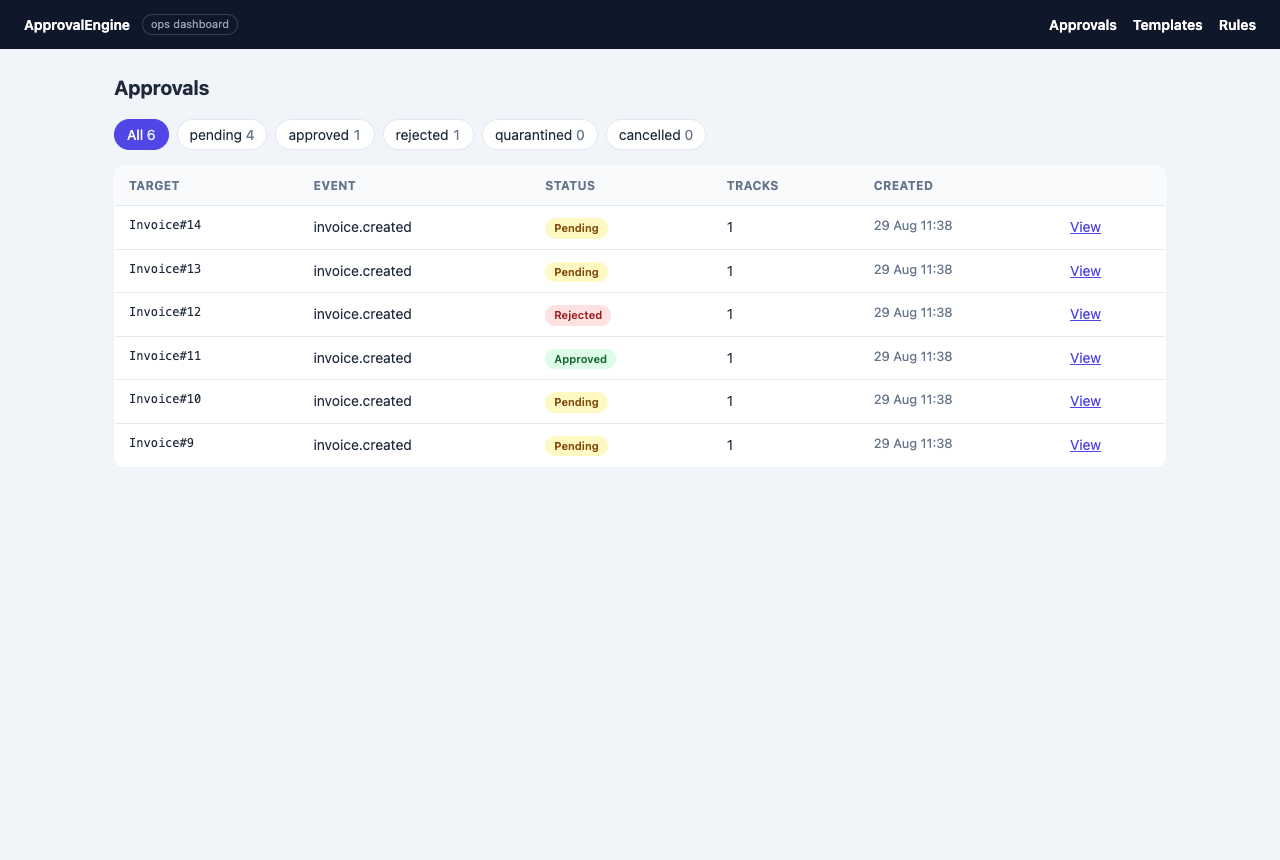
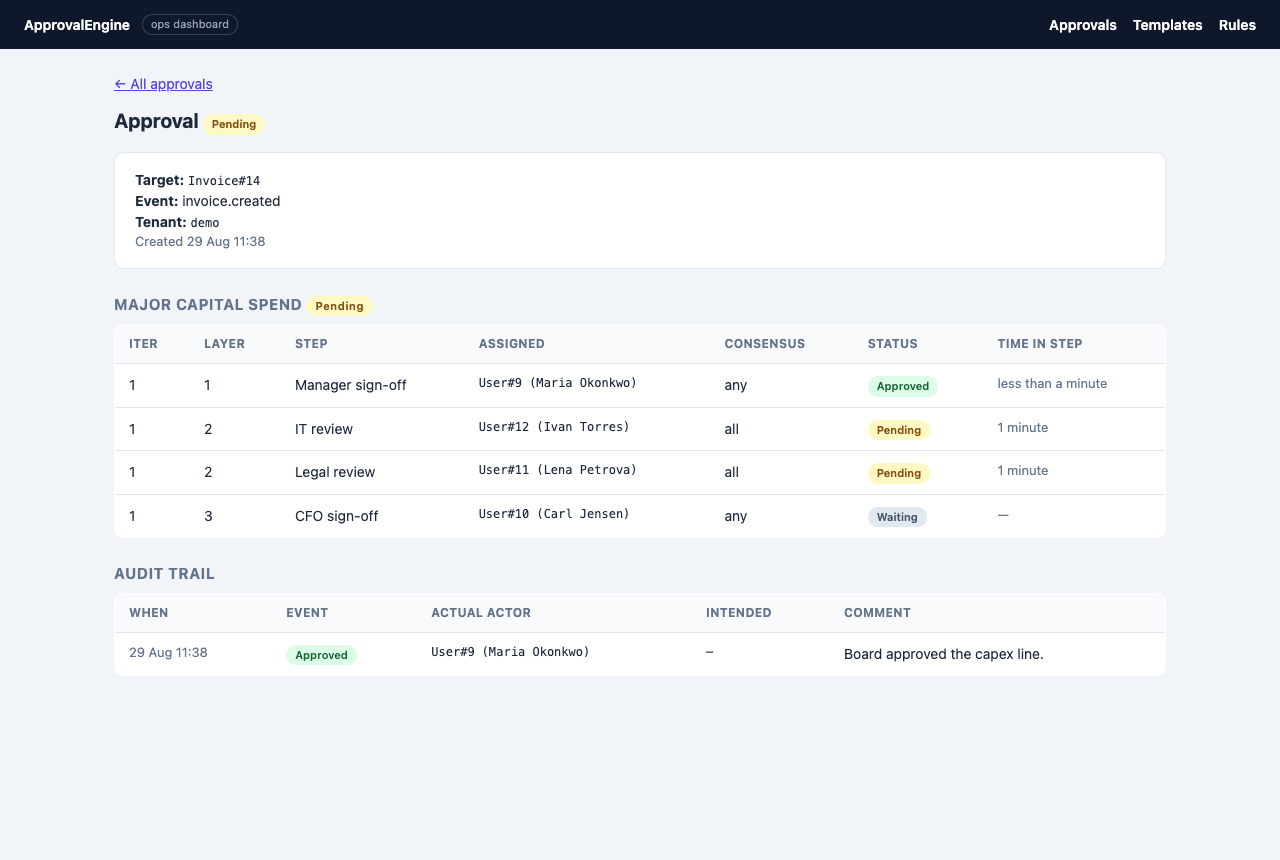
Mount the engine and you get an ops dashboard: every approval, filterable by status, drilling into tracks, steps, the full audit trail, and a time-in-step column so a stuck approval is visible instead of reported.
# config/routes.rb
authenticate :admin_user, ->(u) { u.super_admin? } do
  mount ApprovalEngine::Engine => "/approval_engine"
end
It is read-only and stays that way — its job is to surface stuck, quarantined and in-flight work without anyone writing SQL, not to act on it. It has no auth of its own; wrapping the mount is your call and your app's (recipe).
Want to see it without installing anything? Clone this repo and run:
bin/demo
# seeds sample data and boots the dashboard at
# http://localhost:3000/approval_engine
Or explore the API in a console preloaded with the same data.
bin/console
>> Rails.application.load_seed
>> ApprovalEngine::Step.pending.first.approve!(by: User.find_by(role: "manager"))The README has claimed since 1.0 that admins change routing rules at runtime,
without a deploy. Since 1.1 there is a UI for it: templates, their steps, and
their trigger rules, editable in the browser under /admin inside the mount.
It is off by default — 1.0 shipped a read-only dashboard that hosts mounted
behind whatever auth they had, and a gem upgrade must never turn that into a
write surface.
ApprovalEngine.configure do |config|
  config.admin_enabled = true
end
Routes are drawn once at boot, so this belongs in an initializer and needs a restart. Turning it on is not authentication. It decides whether the write routes exist at all, not who may reach them — anyone who can reach the mount can change what routes where, so keep the mount behind your own constraint either way.
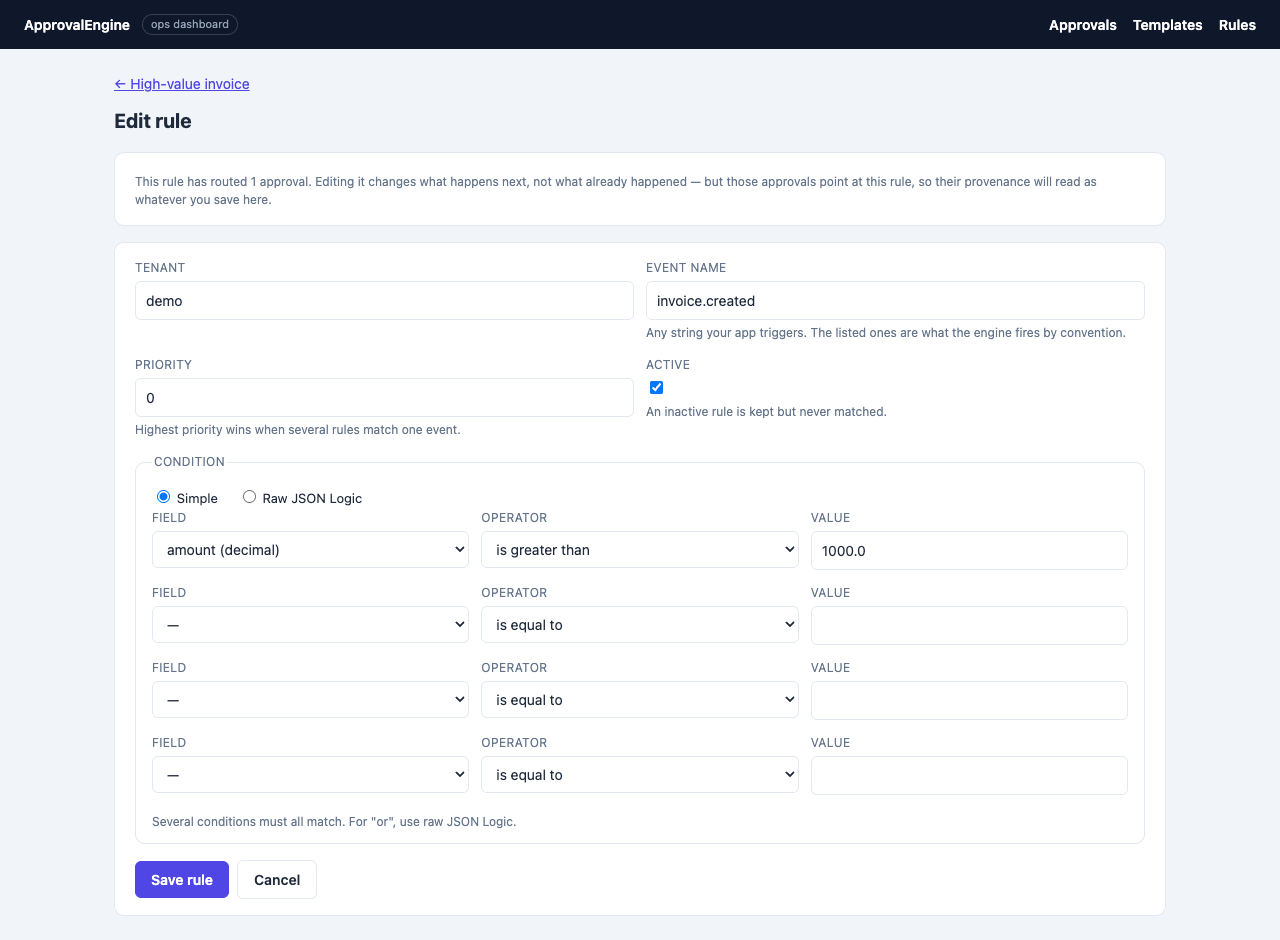
Rules get a form instead of a JSON blob: pick a field, an operator, and a value,
and the engine stores the JSON Logic. The field dropdown is populated from
exposes_for_approval, so it offers the names a rule may actually read — an
unexposed variable is a clean non-match, which is the single most common way a
hand-typed rule silently never fires. There is no JavaScript involved.
A rule too complex for the simple form — an or, a nested group, a substring
in — opens in a raw JSON Logic textarea instead of being quietly flattened
into something it isn't. That fallback is the point: the form is a convenience
over the storage format, never a lossy replacement for it.
The audit trail is the point of the ledger and is never swept. The outbox is not — it is a queue, one row per activation, decision and outcome, and a relayed row has no reader. Sweep it on whatever schedule you already run:
ApprovalEngine::OutboxEvent.purge!                     # relayed, older than 30 days
ApprovalEngine::OutboxEvent.purge!(older_than: 7.days)
Dead letters are kept whatever their age — an event that exhausted its retries
is evidence of a callback that needs fixing, not litter. Find them with
ApprovalEngine::OutboxEvent.failed, and clear failed_at to let the relay
pick one up again.
| Term | What it is |
|---|---|
| Template | The reusable blueprint: ordered layers of steps with consensus rules |
| Trigger rule | A tenant-scoped JSON Logic condition that selects a template for an event |
| Approval | One run: a host record fanned out into one or more parallel tracks |
| Track | One parallel path of layered steps within an approval |
| Step | One approval slot in the immutable ledger (approve! / reject! / request_changes!) |
| Consensus | How many approvals a layer needs: approvals_required — :any, :all, :majority, a percentage like "60%", or a count |
Every run is Approval -> Track -> Step, even the one-approver case.
A single-track run is an approval with one track, not a special path.
You never build that chain by hand: start a run with
run_approval! and act on a step with step.approve!. The
layers surface only when you need them, such as parallel tracks or the
dashboard. For a single-track approval, approval.track reads it back without
.first, and approval.step does the same for an approval that has exactly one
step — it is sole, so it raises rather than guess when there are two, which is
the case for the manager-then-CFO flow above.
approvals_required is one idea used at two levels: within a layer (how many of
its steps), and across the parallel tracks of a scatter-gather (how many tracks
must approve — :all by default). Beyond the happy path, an approval can be
withdrawn (approval.cancel!) and a stuck step escalated (step.reassign!).
Reacting to outcomes — define any of these on your model and the engine
calls them (via the outbox, at-least-once and unordered): after_approved,
after_rejected(reason), after_cancelled(reason), on_quarantined(reason),
after_step_approved/rejected/changes_requested/expired/reassigned(step),
on_step_timeout(step). Or subscribe to the matching approval_engine.*
notifications.
See docs/COOKBOOK.md for copy-paste recipes covering every supported case, from "any two of five reviewers" to "Legal and IT in parallel" to delegation and requesting changes.
| Concern | Mechanism |
|---|---|
| Auditability | Append-only Step ledger; requesting changes appends an iteration instead of editing history |
| Concurrency | Approval-scoped pessimistic lock around every transition, so no double-approvals |
| Routing | JSON Logic ASTs in jsonb, evaluated by shiny_json_logic |
| Side-effects | Transactional outbox relayed by ActiveJob, so a down API never rolls back an approval |
| Safety | A malformed rule quarantines the approval instead of raising |
A missing attribute is a clean non-match, since JSON Logic treats it as
false, so the approval just doesn’t start. Only a malformed rule, such
as an unknown operator, quarantines. The approval never crashes either
way. Set config.raise_on_rule_errors = true to surface errors loudly.
For the full design — the model hierarchy, the consensus/rework model, and why the outbox exists — see docs/ARCHITECTURE.md.
"Which gem" is a real question, so: honest neighbours.
- A boolean column. Genuinely the right answer for one approver and one yes/no. See above for what to do when it stops being.
- AASM / state_machines. Better than this gem at modelling your domain's states. They don't know what an approver is, so multi-party consensus, delegation, and the audit trail stay yours to write.
- ringlesoft/laravel-process-approval. The same idea in Laravel, and worth reading if you are comparing across ecosystems.
- A workflow or BPM service. If your approvals are one node in a much larger orchestrated process, buy that instead of building it on ActiveRecord.
This gem is young, and worth saying so plainly: 1.0 shipped in June 2026 and was never announced, so real-world usage is close to none. The API is stable and every documented recipe is exercised by the test suite, but it has not met your edge cases yet.
ApprovalEngine needs Ruby 3.2+ and PostgreSQL 13+.
bin/setup
bin/rails app:test
bundle exec rubocop
Point at any Postgres with DATABASE_URL if you're not on the default
socket. See CONTRIBUTING.md for the full guide.
Bug reports and pull approvals are welcome on GitHub at https://github.com/Harry-kp/approval_engine. Please read CONTRIBUTING.md and our Code of Conduct.
Available as open source under the terms of the MIT License.