Stream-Voice-Anon: Enhancing Utility of Real-Time Speaker Anonymization via Neural Audio Codec and Language Models


1Nanyang Technological University, Singapore
2Institute for Infocomm Research, A*STAR, Singapore
3The Hong Kong Polytechnic University, Hong Kong
* Equal contribution
Important
📣 Our extension, StreamVoiceAnon+, has been accepted to Interspeech 2026! Expand the section just below for the paper, authors, and approach.
StreamVoiceAnon+: paper, authors & details (click to expand)
StreamVoiceAnon+: Emotion-Preserving Streaming Speaker Anonymization via Frame-Level Acoustic Distillation


1Nanyang Technological University, Singapore
2Institute for Infocomm Research, A*STAR, Singapore
3The Hong Kong Polytechnic University, Hong Kong
StreamVoiceAnon+ extends StreamVoiceAnon to keep the speaker's emotion through anonymization, not just the spoken content. You can find more details in our paper.
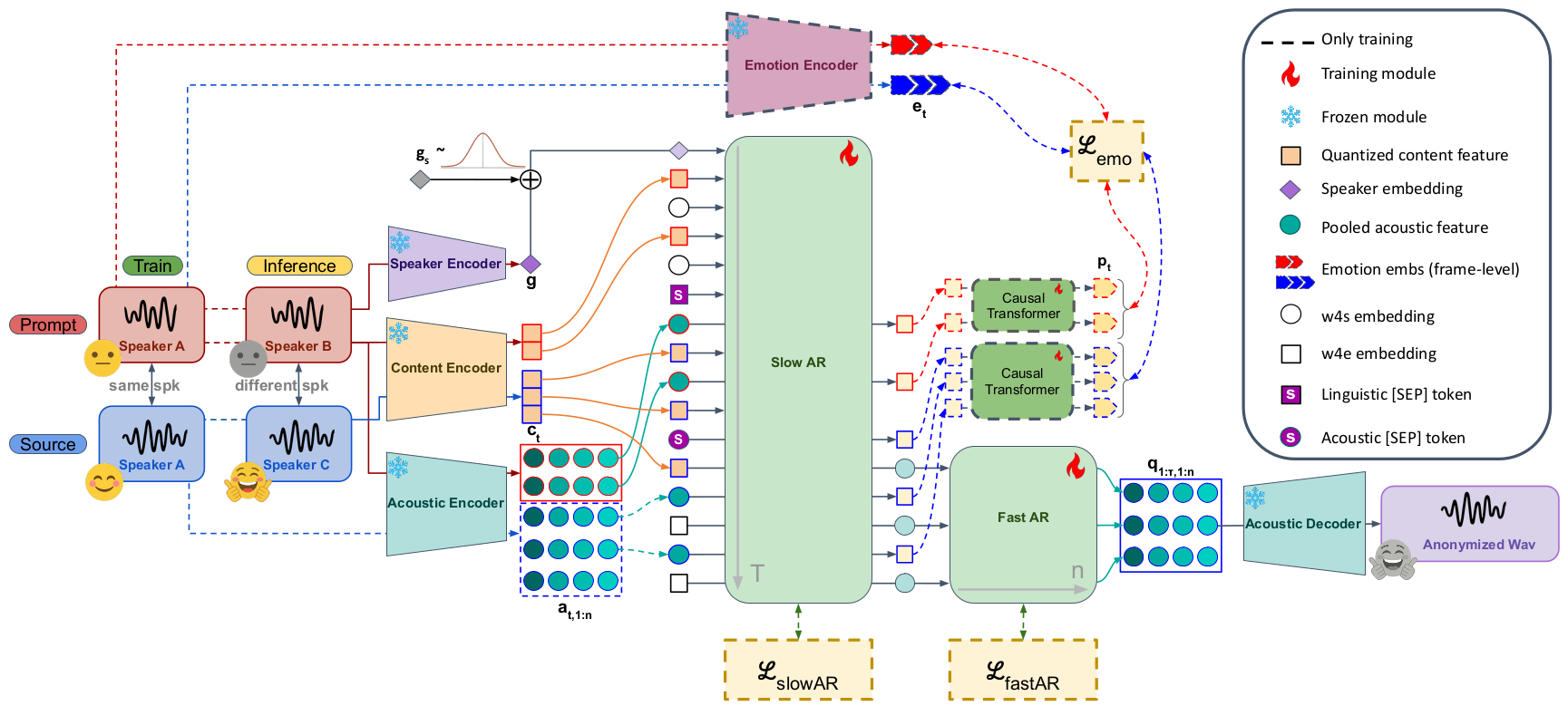
Training / inference pipeline for StreamVoiceAnon+.
This repository contains the implementation of StreamVoiceAnon, a real-time voice anonymization / voice conversion model.

(a) Training |

(b) Inference |
git clone https://github.com/Plachtaa/StreamVoiceAnon.git
cd StreamVoiceAnon
pip install -r requirements.txt
If running on Windows OS, please install the following:
pip install triton-windows==3.2.0.post13Note that this is compulsory to run inference with RTF < 1.0
Full MacOS support is still under construction.
hf download Plachta/StreamVoiceAnon --local-dir pretrained_checkpoints/Below is an example command to launch single node multi-GPU training with streaming Emilia dataset from HuggingFace:
accelerate launch trainers/arvc_trainer.py --config_path configs/config_firefly_arvcasr_8192_delay0_8.yaml --mixed-precision bf16Above command uses default content encoder and trains only the VC model. To train your own content encoder, run the following command instead:
accelerate launch trainers/asr_trainer.py --config_path configs/config_asr_bsq_8192.yaml --mixed-precision bf16To customize model config or training datasets, we encourage users to read config files or training code.
Offline inference
python evaluations/infer_arvc.py \
    --src_path <path_to_audio> \
    --ref_path <path_to_audio> \
    --out_dir <path_to_output_directory> \
    --delay 2 \  # Specify delay in number of frames (must have)
    --compile
Simulated online inference
python evaluations/infer_arvc.py \
    --src_path <path_to_audio> \
    --ref_path <path_to_audio> \
    --out_dir <path_to_output_directory> \
    --delay 2 \  # Specify delay in number of frames (must have)
    --compile \
    --simulate_streaming \
    --decode_chunk_frames 1 # how many frames for encoder & vocoder to process each time
This simulates a chunk-by-chunk online inference with specified chunk size. src_path (source audio) has no length limit here. ref_path (reference audio) will be truncated to some maximum length (if longer than that limit)
Use the --alpha flag to control the noise mixing ratio on speaker embeddings. A value of 1.0 means no noise (pure voice conversion), while lower values blend more noise into the speaker representation for stronger anonymization.
python evaluations/infer_arvc.py \
    --src_path <path_to_source_audio> \
    --ref_path <path_to_reference_audio> \
    --out_dir <path_to_output_directory> \
    --delay 2 \
    --alpha 0.8 \
--compileProvide multiple --ref_path entries to derive a combined speaker representation from several reference utterances. Using multiple references further improves privacy protection, making it harder to trace back to real speaker and better distorting the source's original speaker characteristics. You can optionally crop each reference to a specific duration (in seconds) with --ref_crop_lengths.
python evaluations/infer_arvc.py \
    --src_path <path_to_source_audio> \
    --ref_path <path_to_ref1> <path_to_ref2> <path_to_ref3> \
    --ref_crop_lengths 5.0 3.0 4.0 \
    --out_dir <path_to_output_directory> \
    --delay 2 \
--compilepython evaluations/infer_arvc.py \
--src_path <path_to_source_audio> \
--ref_path <path_to_ref1> <path_to_ref2> \
--ref_crop_lengths 5.0 5.0 \
--out_dir <path_to_output_directory> \
--delay 2 \
--alpha 0.7 \
--compileReal-time inference
python evaluations/real-time-gui.pyThis UI uses the same behavior as simulated online inference. It uses --compile by default, so please ensure you have installed triton (as previously stated) before using it.
If you find our repository valuable for your work, please consider giving a star to this repo and citing the relevant papers:
StreamVoiceAnon (ICASSP 2026)
@misc{kuzmin2026streamvoiceanonenhancingutilityrealtime,
      title={Stream-Voice-Anon: Enhancing Utility of Real-Time Speaker Anonymization via Neural Audio Codec and Language Models},
      author={Nikita Kuzmin and Songting Liu and Kong Aik Lee and Eng Siong Chng},
      year={2026},
      eprint={2601.13948},
      archivePrefix={arXiv},
      primaryClass={eess.AS},
      url={https://arxiv.org/abs/2601.13948},
}
StreamVoiceAnon+ (Interspeech 2026)
@misc{kuzmin2026streamvoiceanonemotionpreservingstreamingspeaker,
      title={StreamVoiceAnon+: Emotion-Preserving Streaming Speaker Anonymization via Frame-Level Acoustic Distillation},
      author={Nikita Kuzmin and Kong Aik Lee and Eng Siong Chng},
      year={2026},
      eprint={2603.06079},
      archivePrefix={arXiv},
      primaryClass={eess.AS},
      url={https://arxiv.org/abs/2603.06079},
}
- Emotion representations: https://huggingface.co/emotion2vec/emotion2vec_plus_large
- Computation resources: https://www.nscc.sg/
- Real-time GUI: https://github.com/RVC-Project/Retrieval-based-Voice-Conversion-WebUI
- Speaker representations (1 of 2) https://huggingface.co/funasr/campplus
- Speaker representations (2 of 2) https://github.com/SparkAudio/Spark-TTS
- Speech acoustic codec https://huggingface.co/fishaudio/fish-speech-1.5
- Idea: https://arxiv.org/html/2401.11053v1
- VoicePrivacyChallenge: https://www.voiceprivacychallenge.org/