Include attributes from spans in log attributes - #3
Conversation


|
Thanks for your contribution! I have few question and suggestion:
fn foo() {
    let span = tracing::info_span!(foo = "bar");
    let _enter = span.enter();
    tracing::info!("foo");
    span.record("foo", &"baz");
}
|

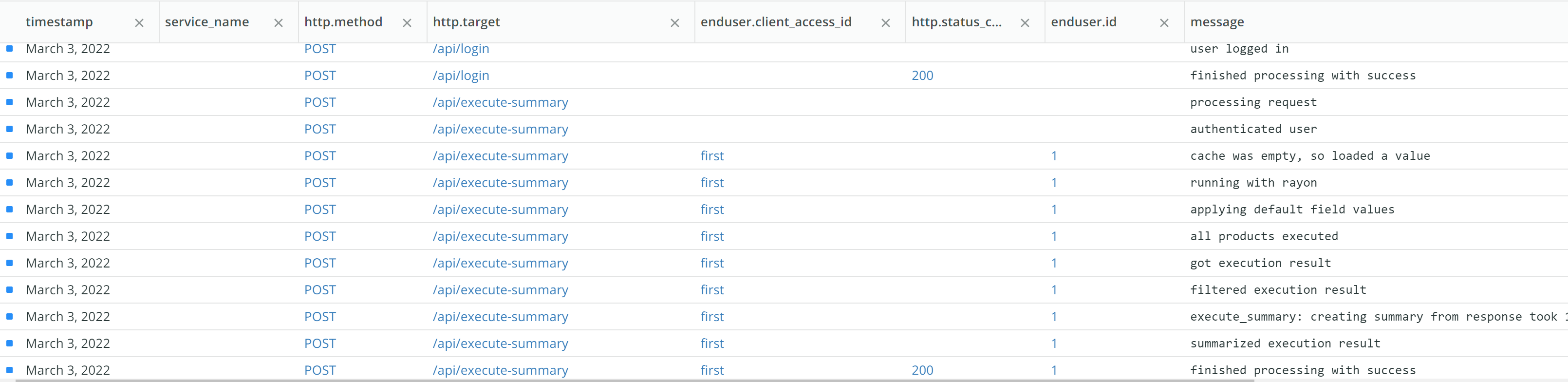
For our use case, we definitely want attributes copied recursively like this. We have a lot of request-level attributes, which can be used for querying or showing logs in a table. Here's an example:
Basically, it's handy to have all the attributes in the chain when viewing or querying logs. (Luckily, when querying traces, you can query by any attribute of any trace, so having the full chain of attributes isn't as useful there).
Hmm, I think that's an interesting idea. From an end-user's standpoint, that would probably be better. With the way logging has been implemented, it seems like it shouldn't be too hard to do it this way. I'll try to see if I can get this working when I have some time to revise this PR.
Also shouldn't be too hard, I'll also try to implement this when I get some time! |

2 participants


This PR updates
NewRelicLayerto include more context when sending logs to New Relic. Specifically, it goes through each span in the event's scope and copies the span's attributes into the log's attributes.As an example use case: imagine your service makes a top-level
requestspan each time an HTTP request gets handled (this is what most Tracing web framework integrations do). Let's say that thisrequestspan has anhttp.targetattribute attached. This PR will attach thishttp.targetattribute to any event emitted in the scope of that span. In New Relic, this means you could add a filter likehttp.target:"/api/hello-world"and get all logs generated from the/api/hello-worldendpoint.I made this change because this matches what our current logging infrastructure does, and we've found it helpful to have span attributes attached to logs in order to filter and browse logs more easily.
I went with a pretty straightforward implementation to get this working, but I'm not sure if it's a good idea to have this behavior enabled without an option to disable it. I'm open to suggestions to revise or improve this PR!