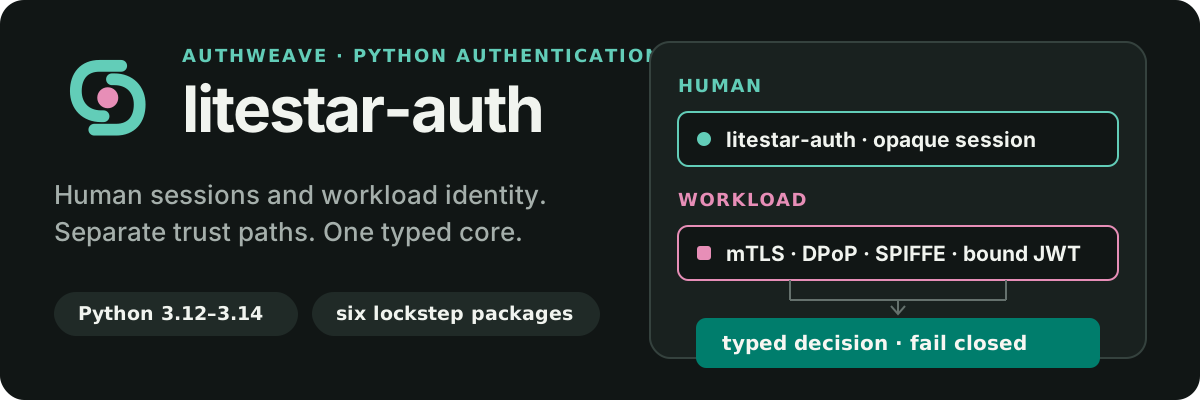


litestar-auth 7 is the human-authentication layer in the six-distribution AuthWeave workspace for
Python 3.12–3.14. Browser sessions and machine credentials stay on separate trust paths while
sharing typed, fail-closed AuthWeave decisions.
uv add litestar-authlitestar-auth— Litestar registration, login, OAuth + PKCE, TOTP, roles, organizations, and opaque database or Redis sessions.uv add litestar-authauthweave-core— Typed principals, evidence, decisions, route policies, and fail-closed provider coordination.uv add authweave-coreauthweave-workload— X.509 lifecycle plus mTLS, DPoP, SPIFFE, bound JWT, and introspection profiles.uv add 'authweave-workload[all]'authweave-otel— API-only security spans and metrics without an SDK or exporter.uv add authweave-otelauthweave-webhooks— Ed25519 Standard Webhooks integrity, replay control, and bounded delivery.uv add 'authweave-webhooks[redis,httpx]'authweave-http-signatures— RFC 9530/RFC 9421 payment-message integrity after machine authentication.uv add authweave-http-signatures
Install only the layer you need; optional integrations stay lazy. All six distributions use one exact lockstep version, and the dependency direction stays one-way:
authweave-core
├── litestar-auth
├── authweave-workload
│   └── authweave-workload[litestar] → litestar-auth Extension SDK v2
├── authweave-otel
├── authweave-webhooks
└── authweave-http-signatures
uv add litestar-auth aiosqlitefrom litestar import Litestar
from litestar_auth import DatabaseTokenAuthConfig, LitestarAuth, LitestarAuthConfig
config = LitestarAuthConfig(
database_token_auth=DatabaseTokenAuthConfig(
token_hash_secret=session_digest_secret,
),
csrf_secret=csrf_secret,
session_maker=session_maker,
user_model=User,
user_manager_class=UserManager,
user_db_factory=user_db_factory,
user_manager_security=user_manager_security,
)
app = Litestar(plugins=[LitestarAuth(config)])The quickstart covers schema requirements and links the runnable
registration/login flow. Use RedisTokenStrategy with litestar-auth[redis] when sessions belong
in Redis. Both implementations issue opaque server-side access tokens. With
LitestarAuthConfig.enable_refresh=True, they also rotate refresh tokens, revoke replayed chains,
and expose safe session metadata.
uv add 'authweave-workload[mtls,jwt,sqlalchemy]'
# Add [litestar] only for the Extension SDK v2 integration.
WorkloadLifecycleService manages service applications, principals, public certificate metadata,
overlapping rotation, revocation, and same-transaction security events. Private keys are rejected
at the package boundary and are never stored.
At request time:
DirectMTLSProviderconsumes trusted TLS peer evidence.MTLSBoundJWTProviderverifies an asymmetric access token from a configured external issuer.- DPoP, SPIFFE, and sender-constrained introspection profiles remain behind explicit extras and route policy.
- Bound tokens or proofs must match the same verified certificate or DPoP key.
- Ambiguous credential ownership and provider failures stop authentication; they never fall through to another provider.
authweave-workload also provides strict outbound RFC 8693 token exchange and typed payment
authorization details. authweave-webhooks and authweave-http-signatures verify message
integrity after authentication; authweave-otel observes outcomes without changing them.
The repository includes an Envoy-based reference stack with negative-path verification:
sh docker/reference/verify.shImportant
Authentication establishes a verified principal and constraints. Your application still owns tenant mapping, row-level security, resource ownership, and business authorization.
Version 7 intentionally does not provide unconstrained bearer login, user-owned API keys, shared-secret machine or request-signing credentials, an OAuth Authorization Server or STS, generic IAM, or production rollout automation. Token exchange is a strict client for an external STS; it does not operate one.
CI exercises Python 3.12–3.14 on Linux, macOS, and Windows. Every distribution has an independent 100% branch-coverage gate, and the repository runs CodeQL, dependency review, pinned-action checks, reproducible builds, per-distribution CycloneDX 1.7 SBOMs and build-provenance attestations, isolated wheel imports, and live PostgreSQL/Redis/proxy reference stacks.
That evidence establishes library readiness, not certification of a particular deployment. The readiness roadmap lists the independent conformance, security-review, KMS, capacity, and operational gates required for production profiles.