A GPS-disciplined NTP server that runs entirely on a Teensy 4.1 + Ethernet, built around
hardware timestamping end to end rather than a general-purpose OS scheduler: GPS PPS
(pulse-per-second) is captured as a hardware timestamp from a timer input capture pin (not a
software/millis() edge poll), and every NTP packet the server receives or sends is
hardware-timestamped by the same onboard 1588 timer at the MAC layer, not timestamped in
software after the fact -- see "Hardware timestamping" below. GPS NMEA sentences (ZDA, or
RMC+GGA) provide the calendar time, and a Theil-Sen regression + chi-squared discipline loop
(not a naive PI loop) steers the 1588 counter.
This is deliberately not the common Raspberry Pi + gpsd + chrony approach, where hardware timestamping is largely absent. A PPS-disciplined RPi setup uses the kernel's GPIO PPS driver, but that's still a software timestamp -- taken by the interrupt handler reading the system clock at the moment it runs, subject to interrupt latency/scheduling jitter, not a timer peripheral latching the edge in hardware. Before the Pi 5, the built-in NICs don't do hardware PTP timestamping either, so the NTP request/response packets chrony actually serves are also software-timestamped after crossing the OS network stack. The Pi 5 can hardware timestamp NTP packets, but that only reduces some of the error. Most setup instructions I've seen for a Raspberry Pi NTP server do not turn on hardware timestamps. This design hardware-timestamps the whole chain instead -- the PPS edge and every served packet alike -- with no OS interrupt latency or scheduling jitter in the loop. It's also cheaper, lower power, and has no SD card (or other storage) to corrupt on power loss.
A few other things that set this apart from a typical GPS-disciplined NTP server:
- Theil-Sen linear regression + chi-squared goodness-of-fit for drift-rate estimation, instead of a naive PI loop
- Compiled-in leap-second table with a TAI-like internal time domain -- steps rather than smears, no reliance on the network for leap-second announcements
- Host-side unit test coverage (ArduinoFake/Unity) for an Arduino sketch -- most of the firmware's logic is exercised without needing real hardware
| Signal | Teensy 4.1 pin | Notes |
|---|---|---|
| GPS PPS | 35 | Hardcoded to the 1588 timer's dedicated event-capture input (InputCapture.cpp); rising edge |
| GPS TX | 0 (Teensy RX1) | GPS_SERIAL in settings.h |
| GPS RX | 1 (Teensy TX1) | wired for completeness; unused by the firmware today (no commands are sent to the GPS module) |
| Ethernet | built-in RJ45 jack | Teensy 4.1's onboard PHY, no external wiring needed |
| Power | 5V/GND or USB | depends on the GPS module |
Any GPS module that outputs standard NMEA (ZDA, or RMC+GGA) with a PPS signal should work --
this was built and tested against a u-blox Neo-7N, but nothing in the firmware is Neo-7N-specific.
Sentence type (ZDA vs. RMC+GGA) and arrival order are detected at runtime (GPS.cpp), not a
compile-time choice.
Every timestamp this server's accuracy actually depends on is captured in hardware, not software:
- PPS input capture -- pin 35's edge is captured directly by the 1588 timer's dedicated
capture channel (
InputCapture.cpp), not polled or timestamped in software. - Incoming NTP packet receive time -- the ENET MAC hardware timestamps each packet as it
arrives (
lwip_t41.c:p->timestamp = bdPtr->timestamp), before software ever sees it. - Outgoing NTP packet transmit time -- likewise timestamped by the MAC hardware once the
packet actually leaves the wire (
enet_txTimestampNextPacket()/enet_set_tx_timestamp_callback()), not estimated at the momentudp_sendto()is called.
The transmit timestamp isn't available synchronously: the hardware only knows it after the
packet has actually gone out, which is after that response has already been built and sent.
NTP interleaved mode exists specifically to deliver that real value back to the client --
the first response to a given client uses a software-estimated transmit time (NTPServer.cpp's
"basic mode" path), but the next request from that same client gets the real hardware-captured
transmit timestamp from the previous exchange instead (NTPClients tracks the pending value per
client). Clients that support interleaved mode (chrony) get the more precise value
automatically; clients that don't still get a correct, just less precise, basic-mode response.
The NTP precision field this server reports is -24 (about 40ns, from the 25MHz 1588 counter
tick), but that's a quantization floor, not the achieved accuracy. In bench testing -- two
Teensys, each with its own GPS/PPS, compared against each other via a real NTP client -- served
time agreed to within a few hundred nanoseconds, well inside the tens-of-microseconds maximum error
bounds of the comparison setup itself.
If GPS/PPS goes quiet for HOLDOVER_STALE_MS (4 seconds, ClockHoldover.h), the server doesn't
just stop -- it enters holdover:
- Discipline switches from the full PID output to just the drift-rate (D) term, since the phase/accumulated-offset terms go stale without fresh samples.
- The reported dispersion estimate keeps growing continuously at
HOLDOVER_PHI_PPM(15ppm, a worst-case oscillator drift-rate bound), rather than freezing at its last real value. - NTP responses keep being served throughout, with the growing dispersion visible to clients.
- After roughly 18.5 hours of continuous outage, dispersion crosses NTP's 1-second reporting threshold and the server falls back to stratum 16 / leap-indicator "unsynchronized" -- telling clients to stop trusting it, rather than serving indefinitely-stale time forever.
- Reconnecting GPS/PPS clears holdover on the next accepted sample, with no clock step.
See TESTPLAN.md section 4 for how to exercise this by hand (pull the PPS line).
- put https://github.com/ddrown/teensy41_ethernet in your Arduino libraries folder
- install Teensyduino (adds Teensy board support to the Arduino IDE)
- Tools > Board > Teensyduino > Teensy 4.1, open
teensy-ntp.ino, compile and upload as normal
PJRC also publishes a Boards Manager-compatible package index, so the compiler, uploader, and
teensy:avr core can be installed without the IDE:
arduino-cli config add board_manager.additional_urls https://www.pjrc.com/teensy/package_teensy_index.json
arduino-cli core update-index
arduino-cli core install teensy:avr
teensy41_ethernet still needs to be git cloned directly into arduino-cli's user libraries
directory (it isn't in the Library Manager index). compile.sh/upload.sh/monitor.sh in this
repo wrap the resulting arduino-cli/tycmd invocations.
For the GPS module itself, you just need PPS, NMEA serial output, and ZDA (or RMC+GGA) messages
enabled -- see settings.h options below for baud rate and other per-device configuration.
| Define | Meaning |
|---|---|
gpsBaudCandidates[] |
GPS module baud rates to try at startup, in order -- see detectGpsBaud() in teensy-ntp.ino. The first candidate that yields a checksum-valid NMEA sentence within ~2 seconds wins; the detected rate is printed over serial. Defaults to {115200, 9600}, since many u-blox modules ship at 9600 and get reconfigured to run faster |
GPS_SERIAL |
Which Teensy hardware UART the GPS module is wired to (Serial1 by default) |
hostnameTable[] |
Maps each board's MAC address to a DHCP hostname, so the same compiled firmware image can be flashed onto multiple boards -- see hostnameForMac() in teensy-ntp.ino. Boards not listed fall back to a generated teensy-xxxxxx name from their MAC. Boot once, read the MAC printed over serial, add an entry, reflash |
For NTP+GPS status, go to http://[ip]
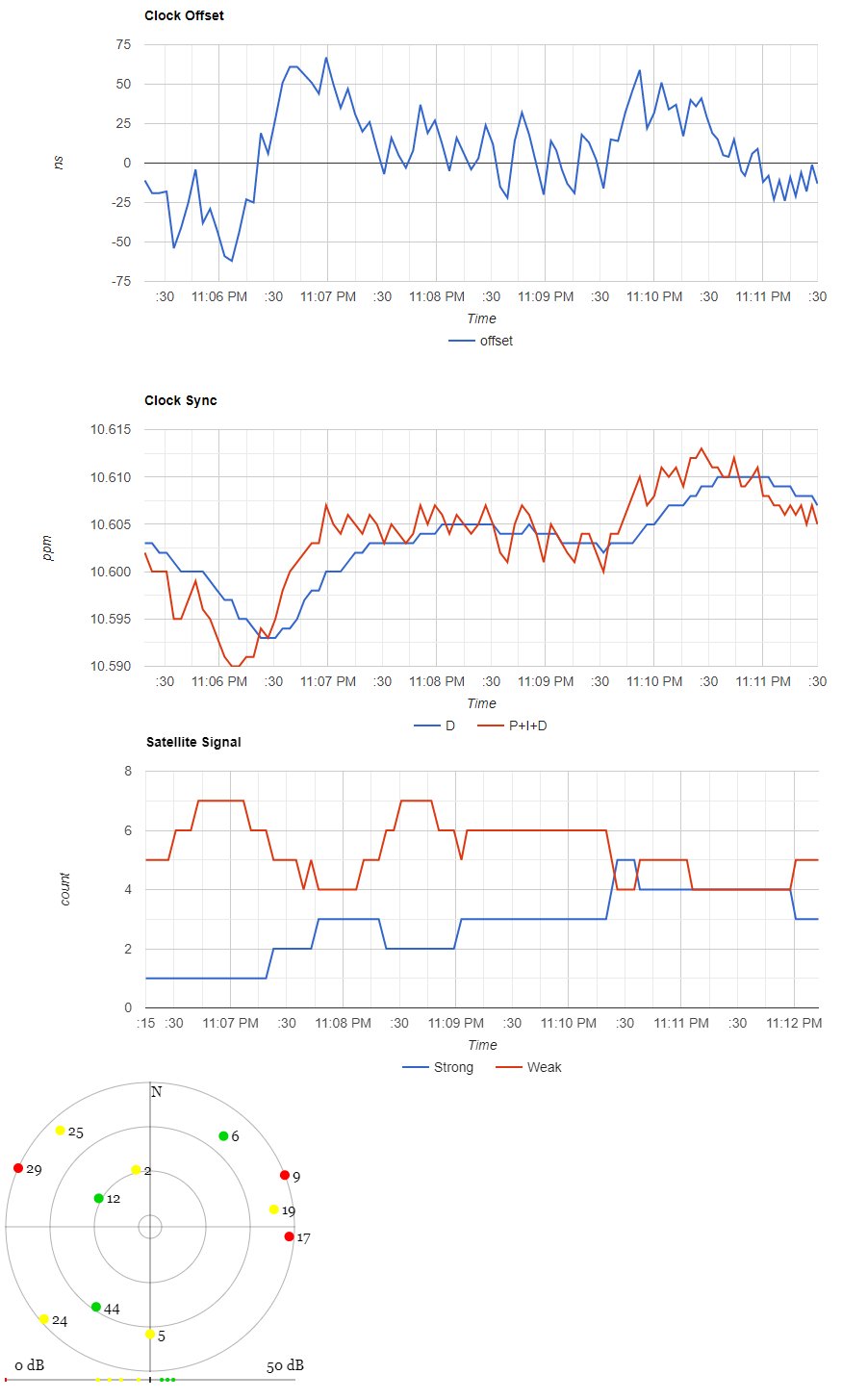
It will start generating a graph of the local Clock Offset, the local Clock Sync parameters, the Satellite Signal strength, and a "radar" view of the GPS satellites overhead.
- No satellites/no signal at all (not just slow to lock): baud rate is auto-detected at
startup against
settings.h'sgpsBaudCandidates[](check the serial log's "GPS baud:" line), so this is less likely than it used to be, but if your module runs at a rate not in that list, add it -- a baud mismatch produces no valid NMEA at all rather than an obvious error (GPS.cppverifies each sentence's checksum and silently drops anything that fails, with no dedicated log line), so it looks identical to "no satellites in view" from the firmware's point of view. Tap the raw UART with a USB-serial adapter to confirm the module is actually decoding at whichever baud rate it's using. - GPS won't lock / slow to lock: a cold start with no cached almanac can take up to ~12.5 minutes; satellite visibility also depends heavily on antenna placement/sky view. You should see satellites showing up in the signal strength graph while the almanac is being downloaded.
- No PPS detected: watch for
LAG <ppsToGPS> <ppsMillis> <gpstime>on the serial console (seeTESTPLAN.mdsection 3 for the full message reference) and confirm holdover engages (inHoldoverin the web/JSON status) rather than nothing happening. Check the PPS wiring to pin 35 specifically.
For host-side unit tests, see the test/ directory (ArduinoFake/FakeIt mocks + Unity). The
full bench verification checklist (dual-Teensy comparison, holdover, leap-second handling,
Y2036 wraparound) is in TESTPLAN.md. Project status/history: open work in TODO.md, completed
work with implementation notes in DONE.md.
IPv4 only:
Memory Usage on Teensy 4.1:
  FLASH: code:95992, data:18708, headers:9200   free for files:8002564
   RAM1: variables:88000, code:93432, padding:4872   free for local variables:337984
   RAM2: variables:12416  free for malloc/new:511872
IPv4+IPv6:
Memory Usage on Teensy 4.1:
  FLASH: code:113208, data:19732, headers:8368   free for files:7985156
   RAM1: variables:92864, code:110648, padding:20424   free for local variables:300352
   RAM2: variables:12416  free for malloc/new:511872
MIT -- see LICENSE.