Warning
This project is an active research prototype and is not production-ready. Features, APIs, and clinical data may change without notice. Do not use in live clinical environments without physician oversight and your own validation. See Section 2 — Clinical Responsibility Statement before use.

Sentra SideLab · Clinical AI Division ferdiiskandar.com |
SideLab is the free Mini edition of Sentra's larger Clinical Decision Support System (CDSS) roadmap. It is released as a lightweight research and community-access prototype, not as the full production CDSS platform. SideLab helps frontline physicians reason more consistently, detect red flags earlier, retrieve local clinical references, and produce structured clinical decision-support output — while preserving physician responsibility as the final clinical authority.
|


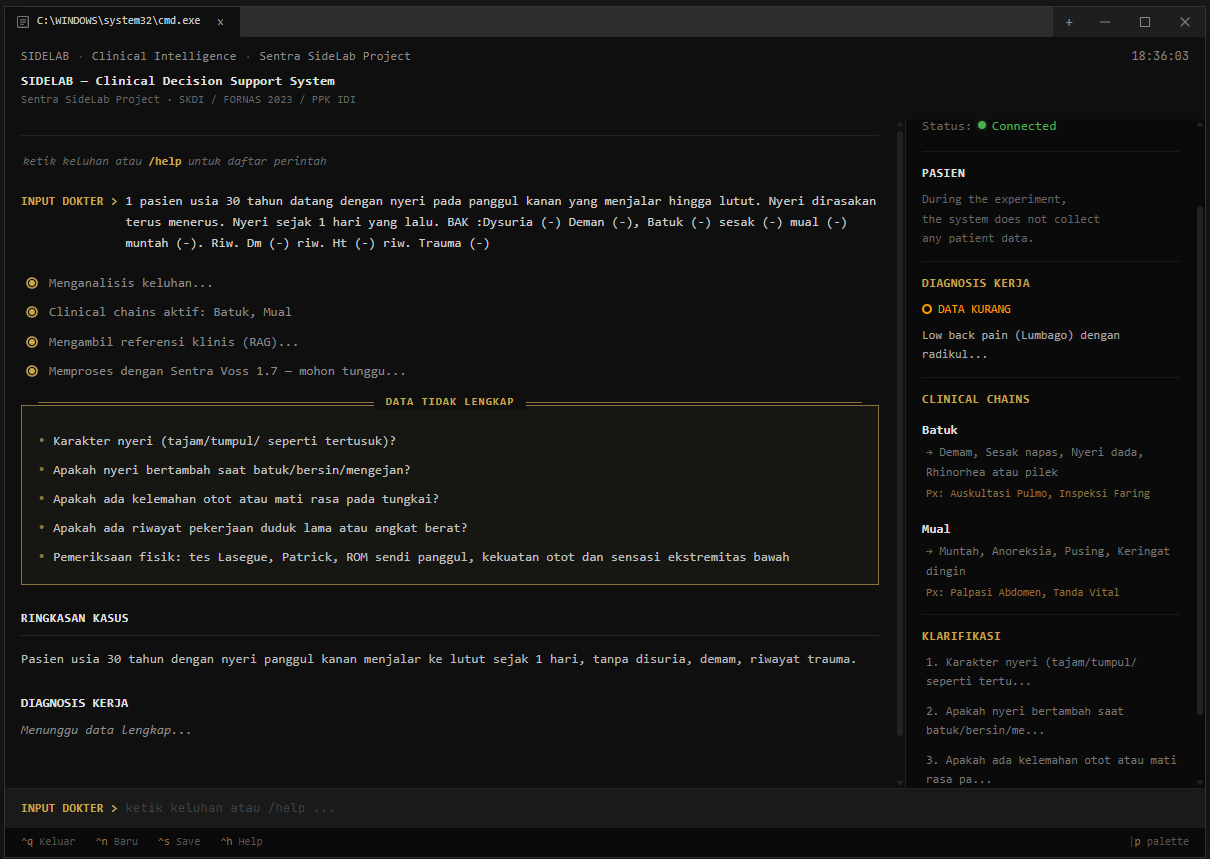
Demo: Clinician types symptoms in the terminal. SideLab surfaces red flags, differential diagnosis, working diagnosis, and initial management steps in structured format.
This preview shows SideLab in practice: the clinician types a complaint, the system processes clinical context, then outputs differential diagnosis, working diagnosis, investigations, and initial recommendations in a structured, reviewable format.
git clone https://github.com/drcodie/sidelab.git
cd sidelab
copy .env.example .env
Open .env and fill in at least one API key — example for DeepSeek:
SIDELAB_DEFAULT_BACKEND=deepseek
DEEPSEEK_API_KEY=sk-...
Then run:
SIDELAB.batFirst-time setup runs automatically (Python, dependencies, Desktop shortcut). Run
SIDELAB.batagain any time after that.Ollama is not required when using a cloud backend (DeepSeek, OpenAI, NVIDIA, etc.). Ollama is only needed for offline-local mode (
SIDELAB_DEFAULT_BACKEND=local).
SIDELAB (Sentra Laboratory for Clinical AI Research) is the free Mini edition of Sentra's broader Clinical Decision Support System (CDSS) initiative. It is provided as a lightweight, offline-first research prototype for Indonesian primary-care physicians working in FKTP / Puskesmas settings.
This repository does not represent the complete Sentra CDSS platform. It is a focused public/research build intended for learning, testing, demonstration, and community-oriented clinical-AI exploration.
It combines:
- local clinical retrieval,
- deterministic red-flag detection,
- Indonesian clinical reference anchors,
- FORNAS-aware pharmacotherapy guidance,
- local drug-stock awareness,
- ICD-10 Indonesia lookup,
- multi-backend LLM routing,
- and structured clinical output through the AUDREY Protocol v1.
The goal is not to replace clinicians. The goal is to make clinical reasoning more structured, safer, auditable, and locally usable.
SideLab is a physician-assistive research prototype, not a physician and not an approved medical device.
All diagnostic conclusions, treatment suggestions, referral suggestions, drug recommendations, and risk assessments generated by SideLab are advisory. They must be reviewed by a licensed physician before any clinical action.
| Principle | Meaning |
|---|---|
| Physician remains accountable | The attending physician is responsible for diagnosis, prescription, referral, and care decisions. |
| AI output must be reviewed | Model output may contain errors, omissions, outdated assumptions, or hallucinations. |
| Red flags are assistive | Emergency warnings support clinical vigilance; they do not replace examination or triage. |
| Input quality matters | SideLab cannot account for missing history, physical examination, labs, imaging, or local context not entered by the user. |
| No autonomous care | SideLab must not be used for unsupervised diagnosis, treatment, or patient-facing automation. |
SideLab is designed around one conservative clinical-AI doctrine:
Retrieve first.
Detect red flags early.
Structure the answer.
Show the boundary.
Let the physician decide.
- No diagnosis without physician review.
- No emergency signal hidden behind LLM generation.
- No medication suggestion without formulary and stock context where available.
- No clinical output without structure.
- No patient-data transmission unless explicitly designed, approved, and governed.
- No production or medical-device claim without proper validation and regulatory pathway.
| Layer | Capability | Purpose |
|---|---|---|
| Clinical Intelligence Engine | RAG v4, semantic retrieval, certainty calibration | Builds structured clinical context from local references. |
| Red Flag Detector | Rule-based pre-LLM emergency scan | Surfaces time-sensitive risk before model generation. |
| AUDREY Protocol v1 | Eight-section clinical response | Keeps output predictable, reviewable, and clinically useful. |
| Drug Stock Integration | FORNAS + local Puskesmas inventory | Reduces unavailable or inappropriate medication suggestions. |
| Multi-Backend Router | 12 LLM providers | Supports offline, cloud, and fallback deployment modes. |
| Textual TUI v2 | Rich terminal interface | Provides usable local UX without heavy infrastructure. |
| ICD-10 Indonesia Lookup | Local code search | Supports standardized diagnostic coding. |
| Session Management | Bounded consultation context | Preserves continuity while controlling prompt growth. |
| Telegram Notification | Consultation alert gateway | Enables asynchronous clinical collaboration. |
| CI/CD Pipeline | Black, isort, Ruff, pytest | Maintains quality gates and regression protection. |
CLINICAL QUERY
    │
    ▼
RED FLAG DETECTION                         ← deterministic, runs before LLM
    │   emergency pattern scan · unmistakable warning panel if triggered
    ▼
LOCAL RETRIEVAL                            ← hybrid scoring pipeline
    │   query profile extraction (tokenize · body-system hints · abbreviation expansion)
    │   TF-IDF + semantic vector scoring · top-3 disease candidates
    │   pharmacotherapy context (FORNAS 2023 · first/second line)
    │   drug stock lookup (local Puskesmas inventory · prefix matching)
    │   red flag context injection
    ▼
PROMPT AUGMENTATION
    │   clinical reference block + stock notes + patient data injected into prompt
    ▼
LLM STREAMING
    │   selected backend · AUDREY Protocol v1 system prompt
    ▼
SAFETY POST-PROCESSING
    │   pharma deduplication · minimum drug floor enforcement
    │   insufficient-data guard · diagnostic frame injection for red flags
    ▼
STRUCTURED CDSS OUTPUT
    │   differential · working diagnosis · investigation · management
    │   pharmacotherapy · patient education · referral · prognosis
    ▼
PHYSICIAN REVIEW
| Component | Technology | Role |
|---|---|---|
| Language | Python 3.12+ | Core application and package modules. |
| Terminal UI | Rich + Textual | Panels, sidebar, rendering, and TUI interaction. |
| Data Layer | JSON flat files | Disease, drug, stock, mapping, vector, and clinical-chain data. |
| Retrieval | TF-IDF + semantic vectors | Local disease matching and reference context building. |
| LLM Runtime | Multi-backend router | Ollama, DeepSeek, OpenAI, NVIDIA, Kimi, Qwen, Zhipu, Yi, Baichuan, Ernie, Spark, Gemini. |
| Clinical Coding | ICD-10 Indonesia module | Local ICD lookup and REPL support. |
| Notifications | Telegram gateway | Structured consultation alerts. |
| Testing | pytest | Clinical, LLM, ICD, notification, installer, and regression tests. |
| CI/CD | GitHub Actions | Black, isort, Ruff, pytest on Python 3.12. |
sidelab/
├── sidelab_tui.py                     # Main Textual TUI launcher
├── sidelab.py                         # Legacy clinical core during TUI migration
├── sidelab/                           # Python package modules
│   ├── intelligence.py                # RAG, chains, vectors, certainty
│   ├── tui.py                         # Textual TUI v2
│   ├── console_bridge.py              # Thread-safe RichLog bridge
│   ├── icd/                           # ICD-10 Indonesia lookup
│   ├── llm/                           # LLM provider router
│   └── notify/                        # Telegram notification sender
├── data/                              # Local clinical databases
│   ├── penyakit.json                  # KKI-classified diseases
│   ├── 144_penyakit_puskesmas.json    # Puskesmas diseases + FORNAS 2023
│   ├── clinical-chains.json           # Symptom-to-disease chains
│   ├── clinical-patches.json          # Edge-case clinical patches
│   ├── penyakit-vectors.json          # Semantic vectors
│   ├── stok_obat.json                 # Local drug inventory
│   ├── obat_data.json                 # Supplementary drug data
│   └── drug_mapping.json              # Generic-to-alias-to-stock mapping
├── tests/                             # pytest suite
├── sessions/                          # Saved consultation histories
├── installer/                         # Windows installer assets
├── build/ / dist/                     # Build artifacts
├── .github/workflows/                 # CI/CD workflows
├── SIDELAB.bat                        # Satu-satunya launcher — auto-setup + jalankan TUI
├── tools/
│   ├── diagnose.bat                   # Diagnostic tool
│   └── run_perf.bat                   # Performance test runner
└── requirements.txt                   # Runtime dependencies
SideLab uses local JSON references to support offline-first operation.
| File | Purpose |
|---|---|
penyakit.json |
KKI-classified diseases with symptoms, signs, red flags, and management context. |
144_penyakit_puskesmas.json |
Common Puskesmas conditions with FORNAS 2023 pharmacotherapy references. |
clinical-chains.json |
Symptom-to-disease prediction chains. |
clinical-patches.json |
Clinical edge-case adjustments. |
penyakit-vectors.json |
Semantic disease vectors for fuzzy matching. |
stok_obat.json |
Local drug inventory: name, strength, quantity, unit. |
drug_mapping.json |
Generic name, alias, and local stock mapping. |
Reference anchors include SKDI, PPK IDI, and FORNAS 2023.
The red-flag layer runs before LLM inference. Its role is to detect high-risk clinical patterns deterministically so that emergency signals are not dependent only on probabilistic generation.
Representative conditions include:
| Risk Pattern | Example Trigger Context | Severity |
|---|---|---|
| Bacterial meningitis | Fever + headache + neck stiffness / nuchal rigidity | Critical |
| Subarachnoid hemorrhage | Sudden severe headache | Critical |
| Stroke | Hemiplegia, aphasia, facial drooping | Critical |
| ACS / STEMI | Chest pain + cold sweat / dyspnea | Critical |
| Traumatic brain injury | Head trauma, loss of consciousness, amnesia | Emergent |
| Sepsis | High fever / rigors + tachycardia / hypotension | Critical |
| Aortic dissection | Tearing chest pain + blood-pressure discrepancy | Critical |
| Pulmonary embolism | Sudden dyspnea + pleuritic chest pain + DVT risk | Critical |
Red-flag output must be interpreted by a physician and integrated with direct examination, vital signs, local protocol, and referral availability.
Every clinical response is constrained into eight sections:
| # | Section | Purpose |
|---|---|---|
| 1 | Differential Diagnosis | At least three alternatives with reasoning and ICD-10 context where available. |
| 2 | Working Diagnosis | Primary diagnosis with justification. |
| 3 | Recommended Investigations | Suggested investigations and expected findings. |
| 4 | Management | Non-pharmacological and clinical management plan. |
| 5 | Pharmacotherapy | FORNAS-aware drug recommendations with dose, interaction, and contraindication context. |
| 6 | Patient Education | Patient and family education points. |
| 7 | Referral Criteria | Emergency, urgent, or elective referral threshold. |
| 8 | Prognosis | Outcome determinants and risk context. |
Pharmacotherapy format:
[Drug Name]
Dose: [dose]; Route: [route]; Frequency: [freq]; Duration: [duration]
DDI: [drug interactions]
CI: [contraindications]
Stock: [available / limited / unavailable / unknown]
| Component | Minimum | Recommended |
|---|---|---|
| OS | Windows 10/11 | Windows 11 |
| Python | 3.12+ | 3.12+ |
| RAM | 4 GB | 8 GB+ |
| Storage | 10 GB | 20 GB SSD |
| Local LLM | Ollama 0.4+ | Ollama 0.5+ |
| GPU | Optional | NVIDIA RTX 3060+ |
REM 1. Clone repository
git clone https://github.com/drcodie/sidelab.git
cd sidelab

REM 2. Create configuration file
copy .env.example .env
REM   Open .env, set SIDELAB_DEFAULT_BACKEND and the API key for your chosen provider

REM 3. Run — first-time setup runs automatically
SIDELAB.bat
Ollama is only required for
SIDELAB_DEFAULT_BACKEND=local(offline mode). For cloud backends (DeepSeek, OpenAI, NVIDIA, etc.), just fill in the matching API key.
REM Run installer if available
dist\SIDELAB-SETUP.exe

REM Or use the Desktop shortcut, or run directly:
SIDELAB.batSIDELAB.batDOCTOR INPUT › Male 55yo, crushing chest pain radiating to left arm,
cold sweat, dyspnea. Hypertension and DM. BP 160/90, HR 110.
Available commands:
| Command | Description |
|---|---|
/pasien nama=X umur=Y jk=L |
Set active patient data (name, age, sex, allergies, comorbidities) |
/provider |
Switch LLM provider / model |
/next |
New case, reset session |
/save |
Save session to file |
/copy |
Copy last response to clipboard |
/help |
Show command list |
/exit |
Exit SIDELAB |
Keyboard shortcuts:
| Shortcut | Action |
|---|---|
Ctrl+B |
Select backend / model |
Ctrl+N |
New case |
Ctrl+P |
Set patient data |
Ctrl+S |
Save session |
Ctrl+Y |
Copy response to clipboard |
Ctrl+Q |
Quit |
Before claiming a change is complete, run the smallest meaningful verification set.
# Format and lint
black .
isort .
ruff check .

# Test collection
python -m pytest --co -q

# Full test suite
python -m pytest
Current reported test scope: 581 tests across clinical logic, retrieval, LLM routing, ICD lookup, notification, installer, and regression domains.
The original prototype dossier reports strong internal validation metrics, including red-flag sensitivity, specificity, diagnosis accuracy, FORNAS compliance, stock match rate, backend support, and user-satisfaction findings.
These figures must be treated as internal prototype validation unless accompanied by:
- published protocol,
- dataset description,
- sampling method,
- external evaluator description,
- prospective clinical setting,
- statistical analysis plan,
- and independent clinical review.
SideLab should therefore be presented as a research prototype, not a validated autonomous clinical system.
| Limitation | Risk | Current Mitigation |
|---|---|---|
| LLM hallucination | Incorrect or fabricated output | Retrieval context, structured prompt, physician review. |
| Incomplete clinical input | Wrong prioritization | Encourage structured case input and SOAP-style details. |
| Limited red-flag coverage | Rare emergencies may be missed | Expand deterministic rules and regression cases. |
| Local data staleness | Outdated treatment or stock context | Versioned updates and periodic review. |
| Prefix-based stock matching | False positives in drug matching | Improve normalization and fuzzy matching. |
| Backend variability | Inconsistent latency and response quality | Router, fallback, and backend-specific testing. |
| Monolithic legacy core | Maintenance difficulty | Continue modularization into package submodules. |
| No strict type checking | Type-related defects | Planned mypy/pyright adoption. |
- Complete TUI-first extraction of
sidelab.pyinto package modules. - Add pre-commit hooks.
- Add
pytest-covcoverage tracking. - Add strict type checking with mypy or pyright.
- Improve drug normalization and stock matching.
- Strengthen red-flag regression tests.
- Expand red-flag rules for SAH, PE, aortic dissection, eclampsia, anaphylaxis, severe dehydration, and pediatric danger signs.
- Add structured uncertainty handling.
- Improve physician-review prompts.
- Define clinical governance protocol.
- Improve Windows installer reliability.
- Add EHR / SIMRS integration pathway.
- Add real-time drug inventory API connection.
- Explore voice input through Whisper or VOSK.
- Prepare controlled field-trial workflow for Puskesmas settings.
SideLab should be modified conservatively.
Think before coding.
Do not assume silently.
Prefer the smallest safe change.
Preserve clinical safety boundaries.
Run relevant tests.
Document what changed and why.
Recommended workflow:
Read context → Identify risk → Propose plan → Make small change → Verify → Summarize handoff
When present, read these governance files before making non-trivial changes:
AGENTS.mdPLANS.mdUSER.md.agent/CONTEXT.md.agent/PROGRESS.md.agent/HANDOFF.md.agent/DECISIONS.md
- Konsil Kedokteran Indonesia — SKDI: Standar Kompetensi Dokter Indonesia.
- Ikatan Dokter Indonesia — PPK IDI: Panduan Penyelenggaraan Pelayanan Kesehatan.
- Kementerian Kesehatan Republik Indonesia — FORNAS 2023: Formularium Nasional.
- Manning, Raghavan & Schütze — Introduction to Information Retrieval.
- Vaswani et al. — Attention Is All You Need.
- Devlin et al. — BERT: Pre-training of Deep Bidirectional Transformers.
- Musen et al. — Clinical Decision-Support Systems.
- Shortliffe & Sepúlveda — Clinical Decision Support in the Era of Artificial Intelligence.
- Kawamoto et al. — Improving Clinical Practice Using Clinical Decision Support Systems.
- Ollama — Local LLM runtime.
- Textualize Rich — Terminal formatting library.
- Textualize Textual — Python TUI framework.
- FAISS — Efficient similarity search.
















❤️ for Alde, Aimee, Audrey & Del
From Indonesia, for a more equitable world of healthcare.
Offline. Trusted. Sovereign.
ferdiiskandar.com